

Pusher Syndrome – by Kyle Whittaker, Student Placement
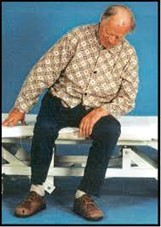
Throughout my placement with Neurotherapy Worx, I have worked with several different conditions. One condition that I have experienced working with is Stroke. A Stroke can affect people differently depending on where the stroke has affected the brain. One place in the brain that can be affected is the posterior lateral thalamus. Damage to this area disrupts a person’s sense of balance and body orientation, causing them to push away from their non-affected side and lean toward the weaker, affected side, even when it leads to instability or falls. This is what is known as Pusher Syndrome.
Pusher Syndrome is something I had not come across before my placement, and it is not something that a classroom typically teaches students to recognise or treat this kind of presentation. Yet, through being on placement, I have found it quite valuable to experience and treat. I thought I would write this blog to explain some of the signs and some of the treatment options available.
Things to look out for
– Someone who is pushed over to their affected stroke side
– Problems with balance
– Someone who is mentally unaware that they are not vertically upright
– Resistance to any passive correction of posture
– Impaired visual perception on their affected side
Treatment Options
Visual/tactile feedback
Due to people who are suffering from Pusher Syndrome not being aware that they aren’t vertically upright, initial rehabilitation could look at providing someone with visual feedback of where they are in space. This can be done by using a mirror in front of the person or providing them with a vertical object (eg, wall or a doorframe) on their non-affected side and asking them to align themselves with this until they can feel themselves pressed against it. Although patients may need prompting initially, it has been shown that regularly providing visual/tactile feedback, patients are able to apply this and utilise their environment to promote a more vertical alignment (Luque-Moreno et al. 2021; Thanaya & Mardhika 2019).
Weight Shifting
Patients with Pusher Syndrome can present with more muscle activity through their non-affected side due to their affected side being weak and stiff, hence being pushed over to their non-affected side. One way to try to calm this overactivity down is to transfer weight towards their overactive side (This can be done in sitting or standing). Getting patients to reach across their body to the non-affected side for a bottle of water could be an example of this. Additionally, shifting weight to the non-affected side will, over time, help correct the patient’s perception of a vertical upright position (Nolan et al. 2023).
Electrical Stimulation
Electrical stimulation has been shown to be effective when addressing the overactivity in the non-affected side in patients suffering from Pusher Syndrome (Fujino et al. 2019). Electrical stimulation uses small, gentle electrical pulses applied to your skin using sticky pads. These pulses help your muscles contract and relax. When used in the right way, this treatment can actually help loosen up stiff muscles and improve movement. However, before using electrical stimulation, please speak to your physiotherapist to see if it will be suitable.
Overall, patients with Pusher Syndrome typically improve with proper intervention. With support from skilled physiotherapists, stroke survivors can regain confidence, relearn balance, and improve mobility.
References
Fujino, Y., Takahashi, H., Fukata, K., Inoue, M., Shida, K., Matsuda, T., Makita, S., & Amimoto, K. (2019). Electromyography-guided electrical stimulation therapy for patients with pusher behaviour: A case series. NeuroRehabilitation, 45(4), 537–545.
Luque-Moreno, C., Jiménez-Blanco, A., Cano-Bravo, F., Paniagua-Monrobel, M., Zambrano-García, E., & Moral-Munoz, J. A. (2021). Effectiveness of visual feedback and postural balance treatment of post-stroke pusher syndrome. A systematic review. Revista Científica De La Sociedad De Enfermería Neurológica (English Ed.), 53, 16–24.
Nolan, J., Jacques, A., Godecke, E., Abe, H., Babyar, S., Bergmann, J., Birnbaum, M., Dai, S., Danells, C., & Edwards, T. G. (2023). Clinical practice recommendations for management of lateropulsion after stroke determined by a delphi expert panel. Clinical Rehabilitation, 37(11), 1559–1574.
Thanaya, S. A. P., & Mardhika, P. E. (2019). Therapeutic approaches for pusher syndrome after a stroke: A literature review. Intisari Sains Medis, 10(2)